Why ACL reconstruction rehab follows a different timeline
The anterior cruciate ligament (ACL) is one of the main stabilisers of the knee, controlling forward movement of the shin bone relative to the thigh and rotational stability during cutting, pivoting and landing movements. When it's torn — most commonly during sport, from a sudden deceleration, twist or awkward landing rather than direct contact — reconstruction replaces it with a graft, usually taken from the patient's own hamstring or patellar tendon (occasionally a quadriceps tendon graft or donor tissue), because the original ligament doesn't reliably heal on its own.
Rehab timelines after ACL reconstruction are dictated less by how a person feels day to day and more by the graft's own biological healing curve: a new graft goes through a phase of weakening as it's revascularised and gradually remodelled into ligament-like tissue, with peak vulnerability typically several weeks to a few months after surgery — well after most people feel confident enough to want to push harder. This is exactly why rehab paced by confidence or pain alone, rather than by time-based and criteria-based milestones, carries a real risk of re-injury or graft stretching.
The rehab phases after ACL reconstruction
The first two weeks focus on protecting the graft and surgical site, controlling swelling, restoring full knee extension — a milestone that's easy to underestimate but critical, since persistent extension loss is one of the most common avoidable complications — and regaining basic quadriceps activation, which is often significantly inhibited after knee surgery regardless of strength beforehand.
From around two to six weeks, the emphasis shifts to restoring a full, comfortable range of movement and a normal walking pattern, alongside closed-chain strengthening (exercises like mini-squats where the foot stays planted) that loads the knee in a way the graft tolerates well at this stage. From roughly six weeks to four months, strength training progresses more substantially — building quadriceps, hamstring and hip strength toward symmetry with the uninjured leg — while higher-impact activity such as running, jumping and cutting generally stays off the table until strength benchmarks, not just the calendar, say otherwise.
Return to running typically isn't considered until quadriceps strength reaches roughly 70–80% of the uninjured side on objective testing, and return-to-sport decisions — usually from around nine months onward, sometimes later — are increasingly guided by a battery of hop and strength tests rather than surgery date alone. Time since surgery on its own is a weak predictor of readiness, and returning too early relative to actual strength and control is a well-documented risk factor for a second ACL injury.
What online physiotherapy assessment and follow-up covers
A video-based ACL rehab assessment tracks the same core markers a physiotherapist would check in person: active and passive knee extension and flexion range measured against the uninjured side, visible quadriceps muscle bulk and activation during a straight-leg raise, walking pattern, and swelling. Many of the strength and control milestones that guide progression — a controlled single-leg squat, step-down quality, balance on the operated leg — can be assessed accurately by camera, with the physiotherapist guiding positioning and giving real-time feedback on technique much as they would in person.
Online follow-up is particularly well suited to the frequent, incremental check-ins ACL rehab actually needs over its many months — adjusting a home or gym programme every one to two weeks as strength and confidence build, without requiring travel for every session. Where objective strength or hop testing is needed at key decision points, particularly the return-to-running and return-to-sport milestones, that's coordinated with in-person testing or the surgical team as appropriate, rather than guessed at remotely.
Red flags and when in-person review is needed
A knee that gives way or buckles unexpectedly during rehab, a sudden increase in swelling or a popping sensation during an exercise, or a new, sharp block to movement should prompt a pause and a physiotherapy review rather than continuing the plan as written. Signs of infection at the surgical site — increasing redness, warmth, discharge or fever — or symptoms suggestive of a blood clot, such as calf swelling, tenderness or breathlessness, need urgent same-day medical assessment rather than physiotherapy. Persistent inability to fully straighten the knee more than a few weeks after surgery is also worth flagging early, since it becomes progressively harder to resolve the longer it's left unaddressed.
A practical starting point
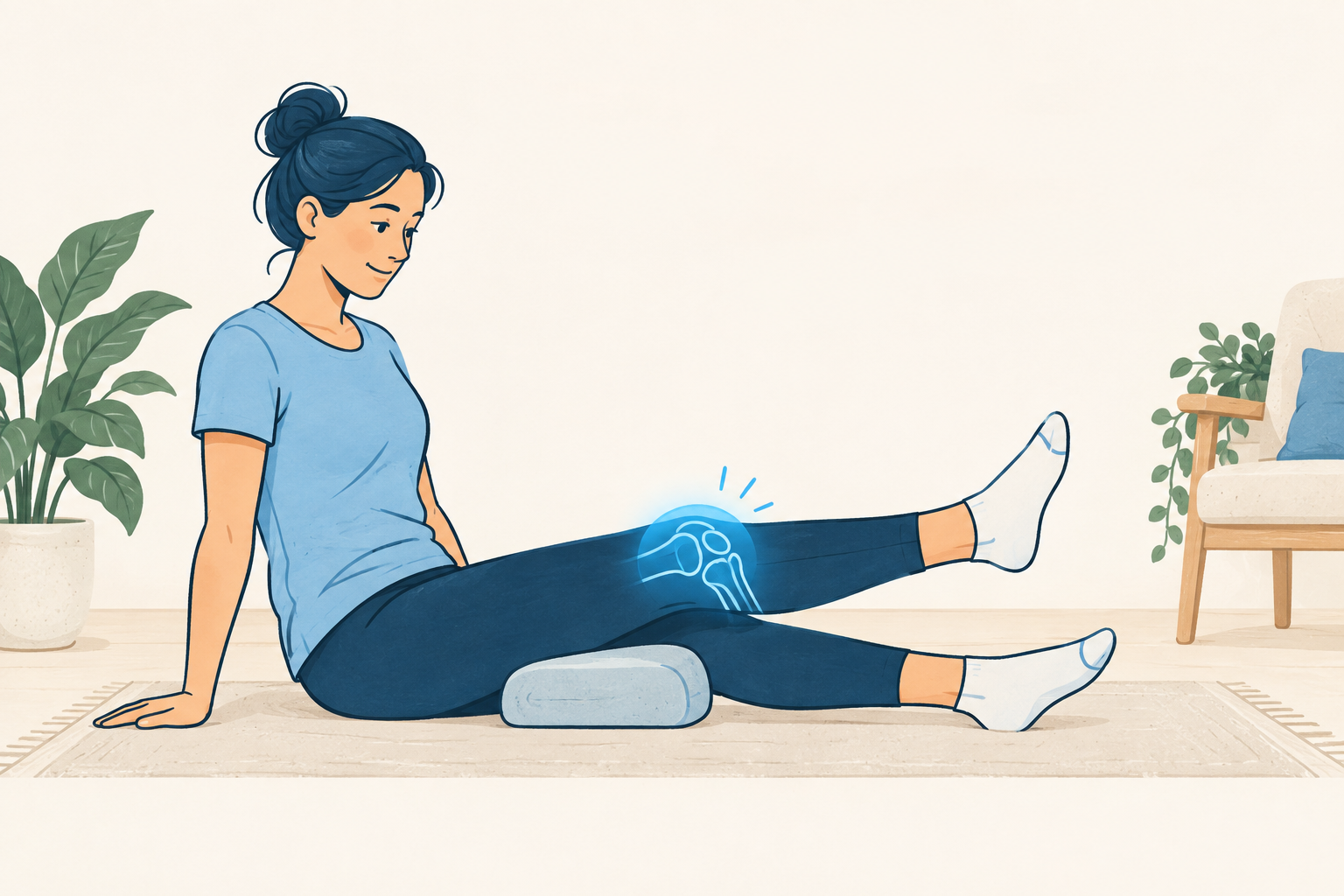
If you're preparing for or recovering from ACL reconstruction, the single most useful thing to track early on is knee extension range compared with your other leg — lie with your heel propped on a small support and let the knee relax straight, checking whether the back of your knee touches the surface the same way on both sides. Losing sight of this early, before strength training becomes the main focus, is one of the more common and avoidable setbacks in ACL rehab.
This guide is part of PhysioOnClick's patient education library and is intended to support informed decisions, not replace an individual assessment or your surgical team's specific protocol. If you're recovering from ACL reconstruction, a full online physiotherapy assessment can build a phase-appropriate plan alongside your surgeon's guidance.